Research in Newfoundland & Labrador
Articles
Fiona Duguid, CEARC Research Fellow
In May 2024, I travelled to Newfoundland conduct research in the co-operative sector. Daphne Rixon, who lives in St John’s, and I are writing case studies on the Newfoundland and Labrador co-operative sector – emerging co-ops and co-ops that are mainstays in their communities.
The Newfoundland and Labrador co-operative sector is few in numbers, about 40 active co-operatives. They are found in a wide range of industries such as finance and banking, housing, construction, retail, administration, and social assistance. Some are mature co-ops that have been contributing in their communities for decades, whereas others are just getting off the ground and others are in the 1–2-year-old range.
Our first foray was into the fishing industry. Fishing is so much a part of Newfoundland’s history and psyche through to today; it is not surprising co-operatives have played a role in this industry. The Fishery Protective Co-operative is a cutting-edge co-op looking to play the part of a democratic broker for harvesters in Newfoundland. We met with Ryan Cleary, long-time activist in the fishing sector, to talk about the development of the FPC. We got Fishing 101 in this conversation and how important the co-op model is for equality, equity, and democracy. According to Ryan, “the FPC will to provide independent owner-operators with greater control over their fishing enterprises and commercial licences, and ensure them a fair, transparent, and more consistent return on their investment”.
In a time when monopolies are rampant, capital is amassing in the hands of few, and participation or democratic process are few and far between, the FPC is looking to make changes in the industry. Stay tuned to see what impact FPC can have in the Newfoundland fishing industry. CEARC will be creating a case study about this emerging co-op.
Next, Daphne and I, made our way over to Bell Island to visit the Bell Island Community Development Co-operative and spin off, The Rolling Pin Bakery. While Bell Island is only a 20-minute ferry ride from St. John’s, you couldn’t be further away from the urban bustle of the city. The Bell Island population was once over 12,000 with a number of iron mines employing miners and a thriving village to support their families. With the mines closing in the 1980s, Bell Island has seen the population dwindle, people shopping off island, and youth leave for employment opportunities elsewhere. Enter the Bell Island Development Co-operative, a non-profit co-op aimed to support the economic and social welfare of Bell Island and Bell Islanders.
The development co-op thought a bakery on island would be a good enterprise to develop. It would provide jobs, food staples (i.e., bread, buns, cookies etc.), and a place to hang out for islanders, while also taking advantage of the growing tourist market with the mine tours. The Rolling Pin Bakery has been in business for 32 years and while it has seen it fair share of ups and downs, it is still active and providing top quality baked goods. Daphne and I can attest to the delicious jam jams, tea buns, and peanut butter balls that Jennifer, Ken, Hailey, and Mary supplied us with.
Daphne and I will be developing a teaching case study on the Rolling Pin Bakery. With teaching cases students work through management, operations, or strategic planning issues embedded in to real life situations and enterprises. We will then filter the students’ suggestions and ideas back to the Rolling Pin for their consideration. More details on the Rolling Pin Bakery in later articles from CEARC.
The Newfoundland and Labrador Federation of Co-operatives (NLFC) are celebrating their 75th this year (for more information, please go to NLFC 75). As a thriving federation they are reinvigorating the co-operative sector, the provincial government, and communities to think co-op! They are making opportunities for communities to start co-operatives and for businesses to think co-op as part of their succession plan. Kristen Murray of the NLFC is working with emerging co-ops through a new Co-operative Incubator Program, while also tackling a co-op conversion of a cafe. Lots of activity and energy to build on.
The trip to Newfoundland wasn’t all work, we also enjoyed many amazing walks, live music, and food that Newfoundland has to offer – can you say chips, gravy and dressing! Whales even made an appearance while we were on a drive “around the Bay”.
With these case studies, CEARC hopes to highlight the ingenuity and doggedness of the Newfoundland and Labrador co-operative sector for a wider audience. As a person who has “come from away”, I am looking forward to seeing the Newfoundland and Labrador co-operative sector grow and thrive, as well as my next trip to Newfoundland.
Island Insights: Bringing Real-World Co-op Stories to the Classroom Fiona Duguid

Fiona Duguid
Last fall, Daphne Rixon, Brad Long, and I, Fiona Duguid, embarked on a remarkable journey through Newfoundland’s unique island communities. Our goal: to develop teaching cases that illuminate the power and diversity of the co-operative business model. Our first stop was the scenic and storied Fogo Island, a place with deep co-operative roots. Historically, community-owned co-ops helped keep employment and money “on island,” preserving livelihoods against the tides of economic change. While fishing remains an important industry, tourism has blossomed thanks to the innovative efforts of Shorefast Foundation—a social enterprise dedicated to place-based economic regeneration.
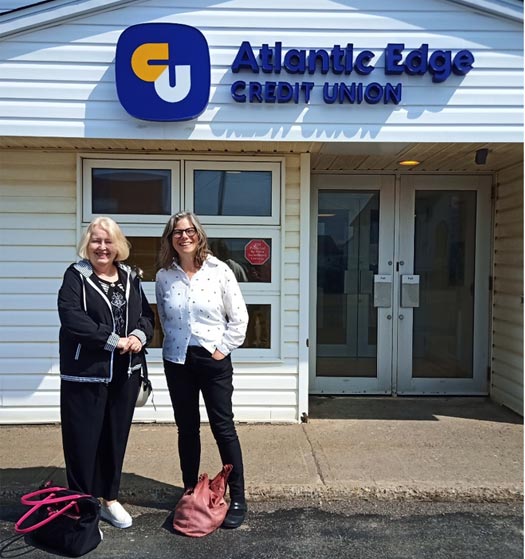
During our visit, we focused on a dramatic recent change in the island’s financial landscape: the conversion of its only bank from Scotiabank to the Atlantic Edge Credit Union (AECU). For two years, the absence of any banking service posed significant challenges for seniors, small businesses, and municipal economic growth. We met with Kayla, Branch Manager, at the new AECU branch, who shared her vision of building a vibrant credit union membership that encourages Fogo Islanders to invest in themselves and their future. We connected with local business leaders, the mayor, a former councillor and sole island accountant, the CEO of the Fogo Island Fishery Co-op, and Shorefast’s CEO. These discussions enriched our understanding of the social dynamics and economic opportunities shaping Fogo’s co-operative ecosystem.
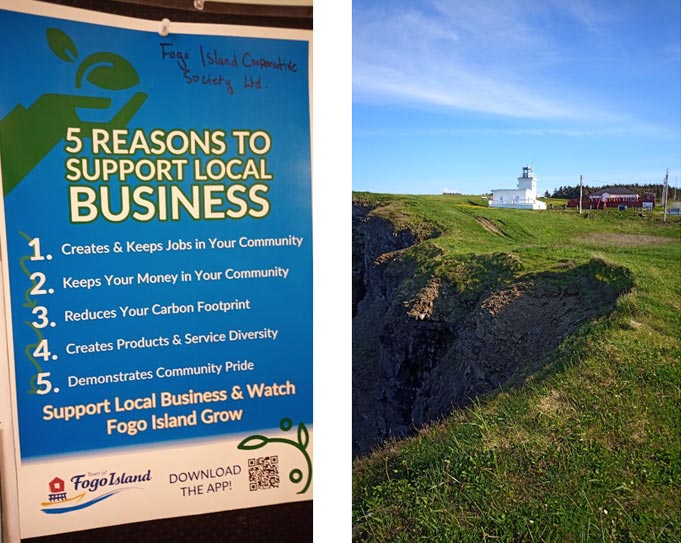
The Fogo Island teaching case invites students to strategize on how Kayla can drive a successful membership campaign, making the credit union a cornerstone of community empowerment.
After Fogo, we journeyed to Bell Island, a striking island rising abruptly from the Atlantic Ocean, historically buoyed by a booming iron mine that once supported over 14,000 residents. Since the mine’s closure in the 1960s, its population has dwindled to approximately 2,500, primarily seniors. Economic opportunities have contracted, local shops have closed, and services are scarce. Amid this backdrop, the Bell Island Community Development Co-operative (BICDC) was formed to revive economic prospects and foster community resilience.
Their flagship effort is the Rolling Pin Bakery, a staple for 37 years that offers local Newfoundland treats and bakery items and provides vital employment. The bakery vividly embodies the potential of co-operatives to sustain and rejuvenate communities. During our visit, we engaged with Ken, Jennifer, and the dedicated bakers, learning about the bakery’s enduring strengths and the challenges it faces. We are writing a teaching case where students will help Jennifer, the Rolling Pin manager, to develop a business plan to guide the bakery forward.
The BICDC itself is in transition, seeking renewal to fulfill the founders’ vision more fully – community economic development. We are writing the teaching case putting the students in Ken and the Board’s shoes asking them to develop a strategic plan including actionable tasks that will make the BICDC a co-operative that is thriving and supporting the Island to thrive. The visits to both islands were inspiring and instructive, offering a wealth of real-world insights to shape our teaching cases. These teaching cases will be submitted to the Ivey Co-op Teaching Case Hub, aimed at connecting business school faculty and students with authentic co-op stories offering differ enterprise examples beyond the usual multinational and core industries. Our time in Newfoundland was memorable not only for the stunning landscapes and warm hospitality but also for the collaborative spirit of those committed to co-operative success. As we prepare our teaching cases for the Ivey Co-op Teaching Case Hub, we express our heartfelt thanks to everyone who welcomed us and shared their experiences. We look forward to contributing these cases to business education and to fostering greater awareness and appreciation of co-operatives’ unique values and impacts. And if you find yourself on Bell Island the jam-jams are a must!